

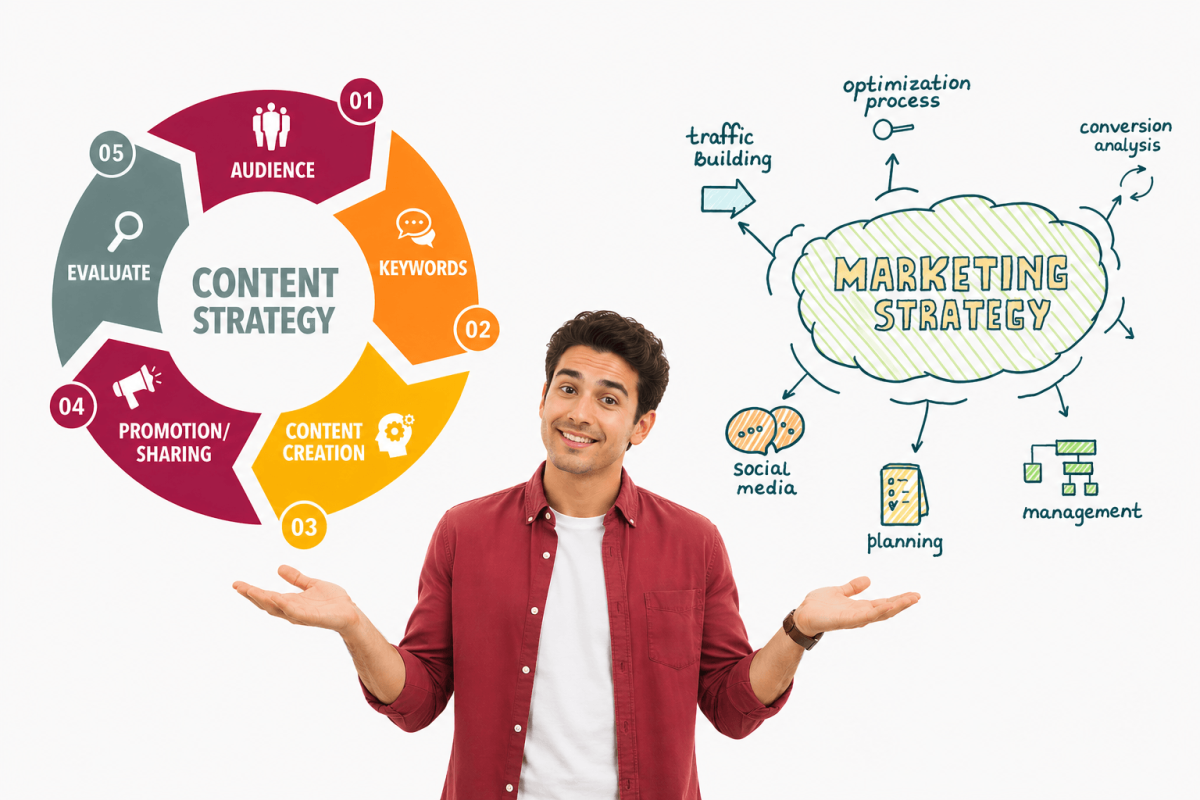
Understanding Strategy in Today’s Digital Landscape
In a digital-first environment, strategy shapes how businesses communicate, compete, and grow. Yet, confusion continues to surround two essential ideas: content strategy and marketing strategy. Many assume they are interchangeable. Others treat them as completely separate. In reality, they are distinct but deeply connected.
A marketing strategy defines direction. It sets goals, identifies opportunities, and determines how a brand positions itself in the market. It answers questions about visibility, reach, and differentiation. It looks outward, focusing on how a business competes and attracts attention.
A content strategy focuses on communication. It determines what is created, how it is delivered, and how it supports broader goals. It ensures that messaging is clear, consistent, and meaningful across platforms. It looks inward, shaping how a brand speaks to its audience.
When these concepts are misunderstood, problems appear. Some businesses invest heavily in campaigns but fail to communicate clearly. Others produce valuable content without a defined goal. Both situations lead to wasted effort and inconsistent results.
Clarity changes everything. When teams understand the distinction, they build stronger systems. They align direction with messaging. They create experiences that feel intentional rather than scattered.
This is where Webdev200 plays a key role. By connecting planning with execution, they help businesses avoid fragmentation. Instead of treating strategy as isolated tasks, they build a cohesive approach that supports long-term growth.
To fully understand how these strategies function, it is important to first break down their differences before exploring how they connect in practice
Key Differences in Structure and Execution
The difference between marketing strategy and content strategy becomes clearer when you examine how each operates within a business.
Here is a direct comparison:
Marketing Strategy
- Defines long-term direction and objectives
- Focuses on brand positioning and visibility
- Determines channels, timing, and approach
- Guides high-level decision making
Content Strategy
- Focuses on messaging and communication
- Shapes what is created and shared
- Supports direction through execution
- Maintains consistency across platforms
To make this more tangible, consider Webdev200’s marketing & branding service. This directly reflects marketing strategy. It defines how a business is presented, how it stands out, and how it connects with its audience at a broader level.

Within that direction, content strategy takes over through content planning. It ensures that messaging aligns with that positioning. It decides what topics to create, how information is structured, and how consistency is maintained across channels.
The difference is clear in responsibility. Marketing defines where the brand is going. Content defines how the brand communicates along the way.
Without this distinction, teams often overlap roles. Campaigns may lack clarity, while messaging may feel disconnected. When each strategy is clearly defined, execution becomes more focused and effective.
In simple terms, marketing provides direction. Content delivers the experience. Both are necessary, but they are not the same.
Where Both Strategies Connect in Practice
Although they are different, content strategy and marketing strategy rely on each other to function effectively. Their connection becomes clear when applied in real scenarios.
Here is how they align:
- Marketing defines audience targeting, while content adapts messaging for that audience
- Marketing selects platforms, while content shapes what appears on them
- Marketing sets goals, while content supports those goals through communication
- Marketing outlines the journey, while content supports each stage

A strong example of this connection can be seen in Webdev200’s web development service. A website is not just a technical build. It is where both strategies meet. Marketing defines its purpose, such as attracting users or generating leads. Content ensures that the site communicates clearly and guides users effectively.
This connection is also visible in campaign execution. A campaign may define timing, channels, and goals. However, without strong messaging, it cannot engage users. Content provides the substance that brings the campaign to life.
The same applies to the customer journey. Marketing defines the stages from awareness to decision. Content ensures that each stage delivers the right message at the right time. Early interactions focus on clarity. Later interactions focus on trust and action.
When both strategies align, the experience feels seamless. Users move naturally from discovery to decision. When they do not align, the experience feels fragmented and inconsistent.
This is why businesses that connect both strategies tend to perform better. They create a unified approach that supports both growth and engagement.
Building Alignment for Better Business Results
Understanding the difference between marketing strategy and content strategy is only the beginning. The real value comes from applying that understanding in a structured way.
Many businesses struggle because they lean too heavily in one direction. Some focus on planning but neglect execution. Others create content without a clear goal. Both situations create inefficiencies.
A balanced approach requires alignment. A strong digital strategy connects planning, messaging, and execution. It ensures that every effort supports a defined objective.
For example, improving conversion strategy requires both direction and communication. Marketing defines what success looks like and how to achieve it. Content builds trust and provides the information needed to guide users toward action.
Webdev200 helps businesses achieve this balance by connecting strategy with execution. Their approach ensures that systems, messaging, and user experience work together. This creates consistency across platforms and improves overall performance.
Businesses that align these strategies often see clearer communication and stronger engagement. Their efforts feel intentional rather than scattered. Over time, this leads to better outcomes and sustainable growth.
If your current approach feels inconsistent, it may be time to reassess how these strategies work together. Even small adjustments can create meaningful improvements.
Contact us today to learn how Webdev200 can help align your strategy and drive better results.